Test & Measurements

제품특징
  • 1. 작은 신호를 위한 수직 해상도 향상
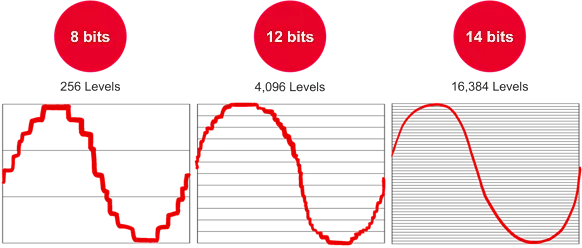
  • 14비트 아날로그-디지털 변환기(ADC)를 사용해 더 작은 신호를 정밀하게 포착할 수 있습니다. 이를 통해 기존 8비트 ADC에서는 볼 수 없었던 세부적인 신호를 확인할 수 있습니다.
  • 수직 해상도를 최대 4배로 향상시켜 작은 신호의 디테일을 정확히 분석하세요.
  • 2. 노이즈 최소화
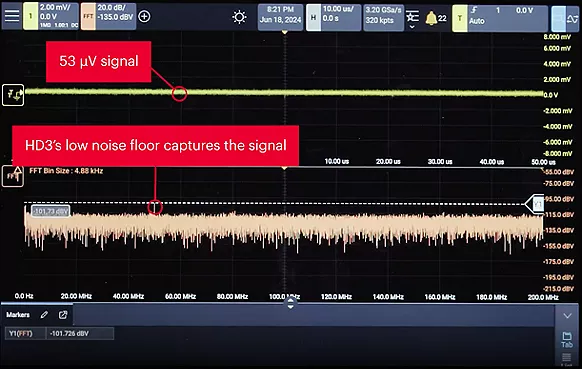
  • 50 µVRMS 노이즈 플로어 덕분에 노이즈 간섭을 줄이고 작은 신호까지 선명하게 볼 수 있습니다. 이는 저진폭 신호 디버깅 시 필수적이며, 신뢰성 있는 측정을 보장합니다
  • 3. 신호 글리치 탐지
  • 초당 130만 파형 업데이트 속도로 매우 빠르게 신호 글리치를 포착할 수 있어 간헐적으로 발생하는 결함을 쉽게 찾을 수 있습니다.
  • 다양한 트리거 옵션과 함께 사용해 글리치가 발생하는 순간을 정확히 확인하세요.
  • 4. 긴 시간 신호 캡처를 위한 딥 메모리
  • 100 Mpts 딥 메모리를 사용해 긴 시간 동안의 신호를 해상도 손실 없이 캡처할 수 있습니다. 이는 복잡한 신호를 오랜 시간 분석해야 할 때 유용합니다.
  • 샘플 속도를 조정해 신호의 전체 대역폭을 확보하면서 긴 시간 동안 데이터를 수집하세요.
  • 5. 다중 신호 독립적 표시 및 스케일링
  • 최대 4개의 신호를 독립적으로 표시하고, 각 채널마다 개별적으로 스케일을 조정해 여러 신호를 동시에 비교할 수 있습니다. 이를 통해 신호의 가시성을 유지하면서 효율적으로 분석할 수 있습니다.
  • 6. 신속한 신호 격리를 위한 영역 트리거링
  • 영역 트리거링 기능을 활용해 특정 신호 부분을 빠르게 격리하고 분석할 수 있습니다. 화면에 관심 있는 부분을 그리기만 하면 해당 신호에 맞춰 트리거를 설정할 수 있어, 문제 구간을 즉시 탐지할 수 있습니다.
  • 7. Keysight Fault Hunter로 자동 분석
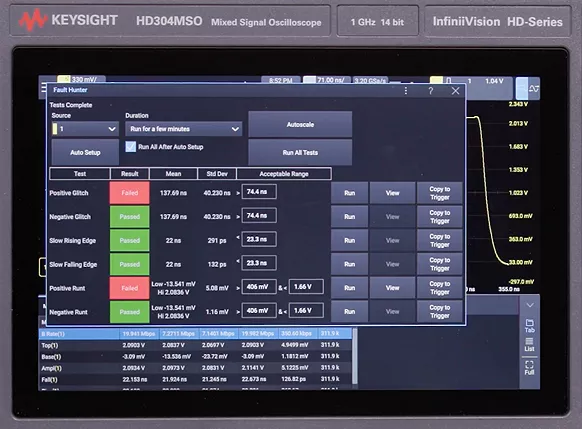
  • Keysight Fault Hunter는 자동으로 신호 오류를 감지해 반복적인 디버깅 작업을 간소화합니다. 이를 통해 자동화된 방식으로 결함을 신속하게 찾아낼 수 있습니다.
  • 8. 고급 신호 분석 기능 활용
  • 다음과 같은 고급 분석 도구를 활용하세요:
  • 고속 푸리에 변환(FFT)을 통해 신호를 주파수 영역으로 변환하여 노이즈나 고조파를 분석합니다.
  • 히스토그램으로 신호의 통계적 데이터를 시각적으로 분석합니다.
  • 보드 플롯을 사용해 제어 시스템 또는 필터 설계에서 위상과 진폭을 분석하세요.

14비트 ADC는 4배의 해상도를 제공합니다  

수직 정확도를 높이는 데 중요한 요소는 ADC(아날로그-디지털 변환기)입니다. ADC 비트 수가 많을수록 수직 해상도가 높아져 신호를 더 정확하게 표현할 수 있습니다.


예를 들어, 12비트 ADC를 사용하는 오실로스코프는 아날로그 입력을 4,096개의 고유한 변환 레벨로 인코딩할 수 있습니다(2^12 = 4,096). 비트가 하나씩 추가될 때마다 변환 레벨 수는 두 배로 증가합니다. 14비트 ADC를 사용하는 오실로스코프는 아날로그 입력을 16,384개의 레벨로 인코딩할 수 있습니다(2^14 = 16,384). 이는 12비트 ADC를 사용하는 오실로스코프보다 4배 높은 해상도를 제공하며, 8비트 ADC에 비해 64배 더 높은 해상도입니다.


50 µVRMS 노이즈 플로어로 더 작은 신호 포착


모든 전자 기기는 오실로스코프를 포함하여 어느 정도의 노이즈를 발생시킵니다. 그러나 목표는 노이즈를 가능한 한 최소화하는 것입니다. 노이즈 플로어가 낮을수록 오실로스코프가 신호에 미치는 영향이 적어져 측정이 더 정확해집니다.

Keysight InfiniiVision HD3는 1GHz 풀 대역폭에서 50 µVRMS 노이즈 플로어로 새로운 기준을 세웠습니다. HD3에서 대역폭 제한 및 파형 평균화 옵션을 사용하면 노이즈를 더욱 줄일 수 있습니다.


고급 분석


고급 소프트웨어 기능을 사용하여 복잡한 측정을 자동화하세요: 고속 푸리에 변환(FFT)을 사용해 시간 영역 신호를 주파수 영역 신호로 변환하세요.

마스크 테스트를 통해 신호를 사전 정의된 템플릿과 비교하여 빠르게 합격/불합격 분석을 수행하세요.

파형 및 측정 히스토그램을 사용해 지터 및 노이즈의 통계적 분포를 분석하세요.

보드 플롯을 통해 주파수 응답 분석을 수행하세요.

영역 터치 트리거링을 사용해 화면에 손가락으로 상자를 그리기만 하면 몇 초 만에 신호를 격리할 수 있습니다.

Fault Hunter를 통해 신호를 특성화하고, 오류를 찾아 자동으로 저장하세요.


7가지 기능을 갖춘 기기


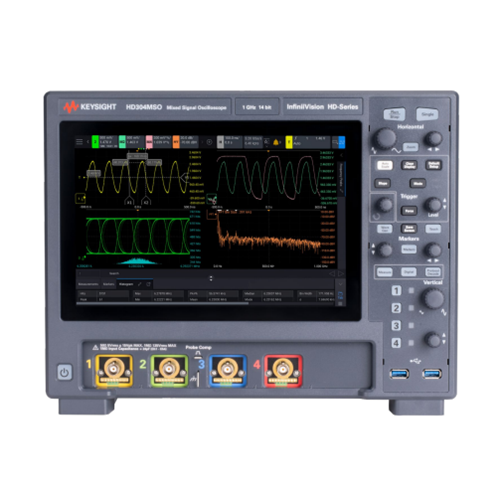
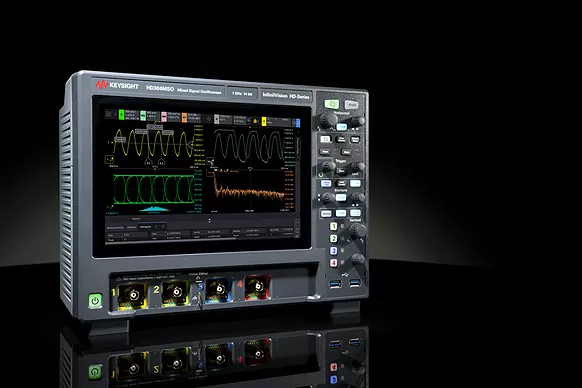
HD3는 단순한 오실로스코프 그 이상으로, 다양한 기능을 통합하여 작업 공간을 절약하고 동일한 공간에서 더 많은 기능을 제공합니다:

두 개 또는 네 개의 아날로그 채널을 가진 오실로스코프 + 16개의 디지털 채널을 추가할 수 있는 혼합 신호 오실로스코프

  • 프로토콜 분석기
  • 주파수 응답 분석기
  • 100MHz 임의 파형 발생기
  • 3자리 디지털 볼트미터
  • 총계기가 포함된 8자리 카운터


모든 응용 분야를 위한 프로브


HD3 오실로스코프와 함께 제공되는 기본 프로브로 오늘부터 시작하세요:

  • Keysight N2843A 패시브 프로브를 사용해 보세요. 이 프로브는 500 MHz 대역폭, 10:1 감쇠비, 10 MΩ의 높은 입력 저항을 제공합니다(채널당 하나 기본 제공).
  • HD3에 기본적으로 포함된 혼합 신호 오실로스코프(MSO) 기능을 탐색해 보세요. Keysight의 16채널 디지털 MSO 케이블을 이미 사용 중이라면, 해당 케이블을 바로 연결하면 됩니다.
  • 추가 기능이 필요하신가요? Keysight는 오실로스코프를 위한 다양한 전압, 전류, 광학 프로빙 솔루션을 제공합니다.


디자인을 가속화하는 기술 지원

오실로스코프 구매 시 다음과 같은 혜택이 포함됩니다:

  • 3년 보증3년 KeysightCare 기술 지원: 무제한으로 기술 전문가와 상담할 수 있으며, 포괄적인 지식 센터에 접근할 수 있습니다. 개인 맞춤형, 선제적, 우선 지원을 받으세요. 지식 센터에서 답을 찾고, 서비스 요청을 관리하며, Keysight 전문가와 소통할 수 있습니다.

  • KeysightCare Enhanced로 업그레이드하면 최대 5년까지 마음의 평화를 유지하고 예산 초과 문제를 없앨 수 있습니다. 보정된 오차 범위 내의 기기와 정확한 측정 결과를 신뢰하세요. 이 서비스는 일부 국가에서 제공됩니다.

Performance Characteristics


HD3 Series Specification Overview

Bandwidth1 (-3 dB)

200 MHz

350 MHz

500 MHz

1 GHz

Calculated rise time (10 to 90%)

2.0 ns

1.3 ns

900 ps

450 ps

Maximum sample rate

3.2 GSa/s per channel

Maximum memory depth

100 Mpts per channel

Display size and type

10.1-inch capacitive touch gesture-enabled display

Waveform update rate

Uncompromised > 1,300,000 waveforms per second


Vertical System Analog Channels

Hardware bandwidth limits

5, 10, 20, 50, 100, 200, 350 MHz, (selectable) Global

40 MHz Each Channel

Input coupling

AC, DC

Input impedance

50 Ω ± 1.5%2

1 ± 1% ll ~24pF

Input sensitivity range

50 Ω 500 uV/div to 1 V/div

1 MΩ 500 uV/div to 10 V/div

Vertical resolution

14 bits (16 bits using bandwidth limits)

Maximum input voltage

135 Vrms; 190 Vpk

Probing technology allows testing of higher voltages. For example, the included N2843A 10:1 probe supports

testing up to 300 Vrms

Use this instrument only for measurements within its specified measurement category (not rated for CAT II, III, IV).

No transient overvoltage allowed

DC vertical gain accuracy1

±1.5% full scale3

DC voltage measurement accuracy

Dual cursor: ± [(DC gain accuracy) + 0.16% full scale]1

Single cursor: ± [(DC gain accuracy) + (offset accuracy) + 0.08% full scale]

DC vertical offset accuracy

± 0.1 div ± 1mV ± 1.5% of offset setting

Channel-to-channel isolation

> 100:1 from DC to maximum specified bandwidth of each model

(measured with same V/div and coupling on channels)

Offset range

50Ω:

500uV/div to 100mV/div: ±1.5V

>100mV/div to 1V/div: ±5V

1MΩ:

500uV/div to 100mV/div: ±1.5V

> 100mV/div to 1V/div: ±15V

>1V/div to 10V/div: ±150V

Noise density

Measured at 101 MHz, span 1 MHz and 15 kHz 


RBW Range (dBM): Noise Density (dBm/Hz)

-38 dBm: -161.2 dBm/Hz

0 dBm: -141.5 dBm/Hz

6 dBm: -133.1 dBm/Hz

Signal-to-noise dynamic range

96 dB (0 dBm 100 MHz input carrier, 0 dBm input range (80 mV/div), 100 MHz CF, 50 MHz span, 15 kHz RBW,

measurement at +15 MHz from CF)

Spurious free dynamic range (SFDR)

79 dB (0 dBm 100 MHz input carrier, 0 dBm input range (80 mV/div), 500 MHz span, 300 MHz CF, 150 kHz RBW)

Amplitude accuracy

±0.3 dB (0 to 1 GHz)

Deviation from linear phase

10° (0 to 1 GHz)


1 Denotes warranted specifications, all others are typical. Specifications are valid after a 30 -minute warm-up period and ± 10°C from firmware calibration temperature

2 Valid for input voltage within ± 8 divisions from offset setting.

3 Full scale is defined as 8 vertical divisions. 500uV/div and 1 mV/div are a magnification of 2 mV/div setting. For vertical accura cy calculations, use full scale of 16 mV for 500uV/div and 1mV/div.


Vertical System Digital Channels

Digital input channels

16 digital (D0 to D15. pod 1: D3 ~ D0, Pod 2: D7 ~ D4, Pod 3: D11 ~ D8, Pod 4: D15 ~ D12)

Thresholds

Threshold per pod

Threshold selections

TTL (+1.4 V), 5 V CMOS (+2.5 V), ECL (–1.3 V), user-defined (selectable by pod)

User-defined threshold range

± 8.0 V in 10 mV steps

Maximum input voltage

± 40 V peak

Threshold accuracy1

± (100 mV + 3% of threshold setting)

Maximum input dynamic range

± 10 V about threshold

Minimum voltage swing

500 mVpp

Input impedance

100 kΩ ± 2% at probe tip

Input capacitance

~8 pF

Vertical resolution

1 bit


RMS Noise Floor (VRMS AC) on 50 inputs

Vertical Setting

20MHz

100 MHz

200 MHz

350 MHz

500 MHz

1 GHz

500 uV/div, 2 mV/div

13u

20u

26u

30u

35u

48u

5 mV/div

16u

25u

33u

38u

44u

59u

10 mV/div

24u

35u

49u

56u

67u

87u

20 mV/div

44u

63u

89u

104u

124u

159u

50 mV/div

92u

141u

202u

239u

286u

366u

100 mV/div

189u

278u

399u

474u

568u

723u

200 mV/div

442u

638u

898u

1.06m

1.26m

1.60m

500 mV/div

942u

1.41m

2.03m

2.41m

2.88m

3.66m

1 V/div

1.78m

2.82m

4.04m

4.79m

5.74m

7.26m


RMS Noise Floor (VRMS AC) on 1M inputs

Vertical Setting

20MHz

100 MHz

200 MHz

350 MHz

500 MHz

500 uV/div, 2 mV/div

21u

34u

50u

76u

96u

5 mV/div

24u

37u

53u

80u

100u

10 mV/div

31u

46u

64u

92u

112u

20 mV/div

51u

72u

97u

132u

154u

50 mV/div

150u

146u

198u

263u

295u

100 mV/div

204u

280u

330u

505u

560u

200 mV/div

454u

686u

947u

1.29m

1.51m

500 mV/div

926u

1.42m

1.95m

2.60m

2.92m

1 V/div

1.96m

2.77m

3.78m

5.01m

5.58m

2 V/div

4.42m

6.76m

9.42m

13.0m

15.1m

5 V/div

9.63m

14.2m

19.5m

26.1m

29.2m

10 V/div

20.2m

27.9m

38.0m

50.3m

55.9m


ENOB (Normal Sample Mode 100mV/div, 1M Ohm) on a 10MHz 90% Full-screen Sine Wave

Input

20 MHz

50 MHz

100 MHz

200 MHz

350 MHz

500 MHz

1 GHz

50

10.4

9.9

9.5

9.0

8.8

8.5

8.2

1M

10.3

9.9

9.5

8.9

8.8

8.4

N/A


Horizontal System Analog Channels

Time base range

500 ps/div to 50 s/div

Time base accuracy1

± 1.6 ppm + aging factor (1 year: ± 0.5 ppm, 2 years: ± 0.7 ppm, 5 years: ± 1.5 ppm, 10 years: ± 2.0 ppm)

Time base delay

time range

Pre-trigger

Maximum of 20M/sample rate, no more than 200s

Post-trigger

Up to 500 sec

Channel-to-channel deskew range

± 100 ns

Δ Time accuracy (using cursors)

Same channel: ± (time base accuracy x reading) ± (0.0016 x screen width) ± 50 ps

Channel-to-channel: ± (time base accuracy x reading) ± (0.0016 x screen width) ± 100 ps

Modes

Main, zoom


Horizontal System Digital Channels

Minimum detectable pulse width

5 ns

Channel-to-channel skew

2 ns (typical); 3 ns (maximum)


Acquisition System

Maximum analog channels sample rate

3.2 GSa/s all channel

Maximum analog channels


record length every channel

20 Mpt with standard license

50 Mpt with 50 Mpt memory license 100 Mpt with 100 Mpt memory license

Maximum digital channels sample rate

1.6 GSa/s all pods

Maximum digital channels record length

20 Mpt

High Resolution

As bandwidth is decreased using the built-in global bandwidth filters, resolution increases up to 16 bits for

high definition. To adjust bandwidth, use the “Acquire” menu.

Acquisition mode

Normal

Default mode

Peak detect

Capture glitches as narrow as 156.25 ps at all timebase settings

Averaging

Selectable from 2, 4, 8, 16, 64, ... to 65,536

Segmented

Segmented memory optimizes available memory for data streams that have long dead times between

activity. Maximum segments = 2000. Re-arm time 1 us (minimum time between trigger events)

Manual

Allows independent selection of sample rate and memory depth

Time mode

Normal

Default mode


Trigger System

Trigger sources

Analog channel (1 ~ 4), digital channel (D0 ~ D15), line, external

Trigger modes

Normal (triggered): Requires trigger event for scope to trigger

Auto: Triggers automatically in absence of trigger event

Single: Triggers only once on a trigger event, press [Single] again for scope to find another trigger event, or

press [Run] to trigger continuously in either Auto or Normal mode

Force: front panel button that forces a trigger

Trigger coupling

DC: DC coupled trigger

AC: AC coupled trigger, cutoff frequency: < 10 Hz (internal); <50 Hz (external)

LF reject: Low frequency reject, cutoff frequency ~ 50 kHz

Noise reject: Selectable OFF or ON, decreases sensitivity 2x

Trigger holdoff range

60 ns to 10.00 s


Trigger Sensitivity

Trigger sources

Analog channel (1 ~ 4), digital channel (D0 ~ D15), line, external

Trigger modes

Normal (triggered): Requires trigger event for scope to trigger

Auto: Triggers automatically in absence of trigger event

Single: Triggers only once on a trigger event, press [Single] again for scope to find another trigger event, or

press [Run] to trigger continuously in either Auto or Normal mode

Force: front panel button that forces a trigger

Trigger coupling

DC: DC coupled trigger

AC: AC coupled trigger, cutoff frequency: < 10 Hz (internal); <50 Hz (external)

LF count: Low frequency reject, cutoff frequency ~ 50 kHz

Noise reject: Selectable OFF or ON, decreases sensitivity 2x

Trigger holdoff range

60 ns to 10.00 s


Trigger System

Internal (noise reject off)

50Ω: 1 LSB resolution, subject to the noise floor of the measurement

1MΩ: 1 LSB resolution, subject to the noise floor of the measurement

External1

200 mVpp from DC to 100 MHz

350 mVpp 100 MHz to 500 MHz


Trigger Level Range

Any channel

± 6 div from center screen

External

± 5 V


Trigger Type Selections

Zone (HW zone qualifier)

Trigger on user-defined zones drawn on the display. Applies to one analog channel at a time. Specify zones as

either “must intersect” or “must not intersect.” Up to four zones. > 300,000 scans/sec update rate

Supported modes: normal, peak detect

Also works simultaneously with the serial trigger and mask limit test

Edge

Trigger on a rising, falling, alternating or either edge of any source

Pulse width

Trigger on a pulse on a selected channel, whose time duration is less than a value, greater than a value, or inside a time

range

Minimum duration setting: 1 ns (500 MHz, 1 GHz), 4 ns (350 MHz), 6 ns (200 MHz), 10 ns (100 MHz)

Maximum duration setting: 10 s

Range difference minimum: 5 ns

Runt

Trigger on a positive runt pulse that fails to exceed a high-level threshold. Trigger on a negative runt pulse that fails to exceed a low-level threshold. Runt triggering can also be time-qualified (< or >) with a minimum time setting of 1 ns and maximum

time setting of 10 s

Minimum time setting: 1 ns (500 MHz, 1 GHz), 4 ns (350 MHz), 6 ns (200 MHz)

10 ns (100 MHz)

Setup and hold

Trigger and clock/data setup and/or hold time violation. Setup time can be set from 0 to 10 s. Hold time can be set from 0 s to

10 S. Setup and hold window can be 3ns minimum.

Rise/fall time

Trigger on rise-time or fall-time edge speed violations (< or >) based on user-selectable threshold

Select from (< or >) and time settings range between

Minimum: 500 ps (500 MHz, 1 GHz), 2 ns (350 MHz), 3 ns (200 MHz), 5 ns (100 MHz)

Maximum: 10 s

Pattern

Trigger when a specified pattern of high, low, and don’t care levels on any combination of analog, digital, or trigger channels is

[entered | exited]. Pattern must have stabilized for a minimum of 2 ns to qualify as a valid trigger condition

Minimum duration setting: 1 ns (500 MHz, 1 GHz), 4 ns (350 MHz), 6 ns (200 MHz), 10 ns (100 MHz)

Maximum duration setting: 10 s

Range difference minimum: 5 ns

Or

Trigger on any selected edge across multiple analog or digital channels

I2C (optional)

Trigger at a start/stop condition or user defined frame with address and/or data values. Also trigger on missing acknowledge,

address with no ack, restart, EEPROM read, and 10-bit write

SPI (optional)

Trigger on SPI (Serial Peripheral Interface) data pattern during a specific framing period. Supports positive and negative Chip Select framing as well as clock Idle framing and user-specified number of bits per frame.

Supports MOSI and MISO data

RS-232/422/485/UART

(optional)

Trigger on Rx or Tx start bit, stop bit or data content or parity error

CAN, CAN FD, CAN XL

(optional)

Trigger on CAN (controller area network) version 2.0A, 2.0B, and CAN-FD (Flexible Data-rate) signals. Trigger on the start of frame (SOF), the end of frame (EOF), data frame ID, data frame ID and data (non-FD), data frame ID and data (FD), remote frame ID, remote or data frame ID, error frame, acknowledge error, from error, stuff error, CRC error, spec error (ack or form or stuff or CRC), all errors, BRS Bit (FD), CRC delimiter bit (FD), ESI bit active (FD), ESI bit passive (FD), overload frame.,

message, message and signal (non-FD), message and signal (FD, first 8 bytes only)

LIN (optional)

Trigger on LIN (Local Interconnect Network) sync break, sync frame ID, or frame ID and data, parity error,

checksum error, frame (symbolic), frame and signal (symbolic)


Waveform Measurements


Markers

Single Marker accuracy: ± [DC vertical gain accuracy + DC vertical offset accuracy + 0.08% full scale]

Dual Marker accuracy: ± [DC vertical gain accuracy + 0.16% full scale]4

Units: Seconds(s), Hz (1/s), phase (degrees), ratio (%)


Automatic measurements

Measurements continuously updated with statistics. Cursors track last selected measurement. Select up to ten measurements from the list below:

Vertical: Peak-to-peak, maximum, minimum, amplitude, top, base, overshoot, pre-shoot, average- N cycles, average- full screen, DC RMS- N cycles, DC RMS- full screen, AC RMS- N cycles, AC RMS- full screen (std deviation), ratio- N cycle, ratio- full screen, Y at X

Time: Period, frequency, counter, T at edge, + width, - width, burst width, +duty cycle, -duty cycle, bit rate, rise time, fall time, delay, phase, X at min Y, X at max Y,

Count: Positive pulse count, negative pulse count, rising edge count, falling edge count Mixed: Area- N cycles, area- full screen, slew rate

Power: Channel power, occupied bandwidth, adjacent power ratio, total harmonic distortion

Automatic measurement logging

Available via BenchVue


Counter (A, B)

Built-in frequency counters

Source: On any analog or digital channel or Trigger Qualified Event (non-Edge Trigger Modes)

Resolution: 8 digits

Maximum frequency: Bandwidth of scope


Waveform Math

Number of math functions

Four Math


Arithmetic

Add, subtract, multiply, divide, differentiate, integrate, FFT, Ax + B, squared, square root, absolute value, common logarithm, natural logarithm, exponential, base 10 exponential, low pass filter, high pass filter, averaged value, smoothing, envelope, magnify, max hold, min hold, measurement trend


Enhanced FFT

Record size

Up to 64 kpts resolution default, can be extended to 32 Mpts

Window types

Hanning, Flat Top, Rectangular, Blackman-Harris, Bartlett

Time gated

FFT

Gate the time range of data for FFT analysis in the zoom view. For time and frequency domain correlated analysis.

Waveforms

FFT, max hold, min hold, average

Peak search

Max 15 peaks, threshold and excursion control


Search, Navigate, and Lister

Type

Edge, pulse width, rise/fall, runt, frequency peak, serial bus 1, serial bus 2

Copy

Copy to trigger, copy from trigger

Frequency peak

Source

Math functions


Max # of

peaks

15


Control

Results order in frequency or amplitude

Result display

Event lister or navigation. Manual or auto scroll via navigation or touch event lister entry to jump to a specific event


Display Characteristics

Display

10.1 inch color 1280x800 (WXGA, TFT-LCD)

Resolution

1280 (H) x 800 (V) pixel format (screen area)

Graticules

8 vertical divisions by 10 horizontal divisions with intensity controls

Maximum waveform update rate

> 1,300,000 waveforms/sec

Persistence

Off, infinite, variable persistence (100 ms to 60 s)

Intensity gradation

16 intensity levels


4 500 uV/div and 1 mV/div is a magnification of 2 mV/div setting. For vertical accuracy calculations, use full scale of 16 mV for 5 00 uV/div and 1 mV/div.


WaveGen Built-in Function/Arbitrary Waveform Generator (typical)

WaveGen out

Rear-panel BNC connector

Waveforms

Sine, Square, Ramp, Pulse, DC, Noise, Sine Cardinal (Sinc), Exponential Rise, Exponential Fall, Cardiac, Gaussian

Pulse, and Arbitrary

Modulation

Modulation types: AM, FM

Carrier waveforms: sine, ramp, sine cardinal, exponential rise, exponential fall, and cardiac Modulation source: internal (no external modulation capability)


AM:

Modulation: sine

Modulation frequency: 1 Hz to 20 kHz Depth: 0% to 100%


FM:

Modulation: sine

Modulation frequency: 1 Hz to 20 kHz Minimum carrier frequency: 10 Hz

Deviation: 1 Hz to carrier frequency or (2e12 / carrier frequency), whichever is smaller

Sine

Frequency range: 0.01 Hz to 100 MHz

Amplitude flatness: ± 0.5 dB (relative to 1 kHz)

Harmonic distortion: –40 dBc

Spurious (non-harmonics): –40 dBc

Total harmonic distortion: 1%

SNR (50 load, 500 MHz BW): 40 dB (Vpp > = 0.1 V); 30 dB (Vpp < 0.1V)

Square wave /pulse

Frequency range: 0.01 Hz to 50 MHz

Duty cycle: 20 to 80%

Duty cycle resolution: Larger of 1% or 10 ns

Pulse width: 20 ns minimum

Rise/fall time: 2.5 ns (10 to 90%)

Pulse width resolution: 10 ns or 5 digits, whichever is larger

Overshoot: < 10%

Asymmetry (at 50% DC): ± 1% ± 5 ns

Ramp/triangle wave

Frequency range: 0.3 Hz to 5 MHz

Linearity: 1%

Variable symmetry: 0 to 100%

Symmetry resolution: 1%

DC

Precise (-1 to 1V) Hi Z

Wide Range (-8 to 8V)

Noise

Bandwidth: 150 MHz typical

Sine Cardinal (Sinc)

Frequency range: 0.3 Hz to 5 MHz

Exponential Rise/Fall

Frequency range: 0.3 Hz to 5 MHz

Cardiac

Frequency range: 0.3 Hz to 200.0 kHz

Gaussian Pulse

Frequency range: 0.3 Hz to 5.0 MHz

Arbitrary

Waveform length: 2 to 8,192 points

Amplitude resolution: 14 bits (including sign bit)5

Repetition rate: 0.3 Hz to 12 MHz

Sample rate: 400 MSa/s

Frequency

Sine wave accuracy: Timebase accuracy ± 1 ppm

Square wave and pulse accuracy: Timebase accuracy ± 3 ppm

Amplitude

Range:

2 mVpp to 10 Vpp into Hi-Z 6,7

1 mVpp to 5 Vpp into 50 6,7

Resolution: 100 μV or 3 digits, whichever is higher

Accuracy: 2% (frequency = 1 kHz)

DC offset

Range: ± 8 V into Hi-Z 6,7, ± 4 V into 50 6,7

Resolution: 100 μV or 3 digits, whichever is higher

Trigger output

Trigger output available on Aux Out BNC

Main output

Impedance: 50 typical

Isolation: Not available, main output BNC is grounded

Output mode

Normal

Single shot (arbitrary, sine, ramp, sine cardinal, exp rise/fall, cardiac, Gaussian pulse)


5 Full resolution is not available at output due to internal attenuator stepping.

6 Gaussian Pulse, Sin, Cardiac: 4 Vpp maximum into Hi-Z; 2 Vpp maximum into 50 Ω.

7 Maximum high level of 8V and minimum low level of -8V into Hi-Z (4V and -4V into 50 Ω) of combined signal amplitude and offset.


Digital Voltmeter (typical)

Functions

ACrms, DC, DCrms

Resolution

ACV/DCV: 3 digits

Measuring rate

100 times/second

Autoranging

Automatic adjustment of vertical amplification to maximize the dynamic range of measurements

Range meter

Graphical display of most recent measurement, plus extrema over the previous 3 seconds


Precision Counter/Totalizer (typical)


Counter

Source

Any analog channel or trigger qualified event (non-edge trigger modes)

Resolution

8 digits maximum

Max frequency

1 GHz (any analog channel)

Trig qual events

1/ (trigger hold off time) for trigger qualified events (max 25 MHz, minimum dead time of 40 ns)

Measurement

Frequency, period, totalize

Totalizer

Counter size

64-bit

Edge

Rise or fall


Connectivity


Standard ports

One USB 2.0 hi-speed device port on rear panel. Supports USBTMC protocol

Two USB 3.0 super-speed host ports, front and rear panel. Support memory devices, mouse, and keyboards

LAN (10/100/1000Base-T)

Aux out

BNC connector on the rear panel. Supported modes: triggers, mask, and waveform generator sync pulse


General and Environmental Characteristics

Power line consumption

Max 275 W

Power voltage range

100 to 120 V, 50/60/400 Hz; 100 to 240 V, 50/60 Hz

Environmental rating

0 to 50 °C with 3000m max

Operating: 80% RH, non-condensing, up to +40°C

Non-operating: 95% RH, non-condensing, up to +40°C; decreasing linearly to 50% RH at +65°C

Electromagnetic compatibility

Meets EMC directive (2004/108/EC), meets or exceeds IEC 61326-1:2012/EN 61326-1:2013 CISPR 11/EN 55011

IEC 61000-4-2/EN 61000-4-2

IEC 61000-4-3/EN 61000-4-3

IEC 61000-4-4/EN 61000-4-4

IEC 61000-4-5/EN 61000-4-5

IEC 61000-4-6/EN 61000-4-6

IEC 61000-4-11/EN 61000-4-11 Canada: ICES-001:2004

Australia/New Zealand: AS/NZS

Safety

ANSI/UL Std. No. 61010-1:2012; CAN/CSA-C22.2 No. 61010-1-12


ANSI/UL Std. No. 61010-2-030:2012; CAN/CSA-C22.2 No. 61010-2-030-12

Vibration

Meets IEC60068-2-6 and MIL-PRF-28800; class 3 random

Shock

Meets IEC 60068-2-27 and MIL-PRF-28800; class 3 random; (Operating 30 g, ½ sine. 11 ms duration,

3 shocks/axis along major axis, total of 18 shocks)

Dimensions (W x H x D)

33.5 cm (13.2 in) x 26.2 cm (10.3 in) x 16.8 cm (6.6 in)

Weight

Net: 5.25 kg (11.6 lbs)


Nonvolatile Storage


Reference waveform display

Two internal waveforms or USB thumb drive.


Data/file save

Setup/image

Setup (*.scp 24-bit Bitmap image (*.bmp), PNG 24-bit image (*.png)

Waveform data

CSV data (*.csv), ASCII XY data (*.csv), Binary data (*.bin), Lister data (*.csv), Reference waveform data

(*.h5), multi-channel waveform data (*.h5), Arbitrary Waveform data (*.csv)

Application data

Mask (*.msk)

Analysis results (*.csv)

Cursor data, measurement results, mask test statistics, search, segmented timestamps

Max USB flash drive size

Supports industry standard flash drives

Internal data storage

Up to 10 GB open for data storage of oscilloscope files.

Secure Erase and save control are available with HD3SECURE

Set ups with USB flash drive

Limited by size of USB drive


Included Standard with Oscilloscope

Calibration

Soft copy of Certificate of Calibration (CoC) downloadable from

https://service.keysight.com/infoline/public/details.aspx?i=DOC, 3-year calibration interval

N2843A Passive probe 500 MHz 10:1 attenuation

1 per channel

Interface and built-in help language support

English, Chinese (simplified), Chinese (traditional), French, German, Italian, Japanese, Korean

Localized overlay

English, Chinese (simplified), Chinese (traditional), French, German, Italian, Japanese, Korean


After-Purchase License-Only Upgrades

Bandwidth Upgrades


Bandwidth upgrade

Model number

2 channel HD302MSO from 200 MHz to 350 MHz

HD3BW-001

2 channel HD302MSO from 200 MHz to 500 MHz

HD3BW-002

2 channel HD302MSO from 200 MHz to 1 GHz

HD3BW-003

2 channel HD302MSO from 350 MHz to 500 MHz

HD3BW-004

2 channel HD302MSO from 350 MHz to 1 GHz

HD3BW-005

2 channel HD302MSO from 500 MHz to 1 GHz

HD3BW-006

4 channel HD304MSO from 200 MHz to 350 MHz

HD3BW-007

4 channel HD304MSO from 200 MHz to 500 MHz

HD3BW-008

4 channel HD304MSO from 200 MHz to 1 GHz

HD3BW-009

4 channel HD304MSO from 350 MHz to 500 MHz

HD3BW-010

4 channel HD304MSO from 350 MHz to 1 GHz

HD3BW-011

4 channel HD304MSO from 500 MHz to 1 GHz

HD3BW-012


Software Upgrades


License Upgrade

Description

Model number

Embedded software package

I2C, SPI, UART (RS232/422/485) serial trigger and decode

HD300EMBA

Automotive software package

CAN, CAN FD, CAN XL (symbolic with .dbc file), and LIN (symbolic with .ldf file)

HD300AUTA


Hardware Upgrades


Model number

Description

HD3MSO

MSO upgrade: add 16 digital timing channels

HD3SECURE

Enhanced security option

Configuring Your Oscilloscope

Step 1: Choose model with number of analog channels

All models come standard with a minimum 200 MHz bandwidth and MSO interface enabled.


HD3 Series Specification Overview


HD302MSO

HD304MSO

Bandwidth (-3 dB)

200 MHz

Calculated rise time (10 to 90%)

3.5 ns

Input channels


Analog

2

4

Digital

16

16


Step 2: Choose your bandwidth upgrade


Bandwidth options

Bandwidth (-3 dB)

Calculated rise time (10 to 90%)

HD302MSO

HD304MSO

200 MHz (standard)

2.0 nsec

HD302MSO-200

HD304MSO-200

350 MHz

1.3 nsec

HD302MSO-350

HD304MSO-350

500 MHz

900 psec

HD302MSO-500

HD304MSO-500

1 GHz

450 psec

HD302MSO-01G

HD304MSO-01G


Step 3: Select memory upgrades


Memory options

Capture memory

HD302MSO/HD304MSO

20 Mpts/channel (standard)

HD300MSO-020

50 Mpts/channel

HD300MSO-050

100 Mpts/channel

HD300MSO-100


Step 4: Select system upgrades


System upgrade options

Feature

HD302MSO/HD304MSO

100 MHz WaveGen

HD3WAVEGEN

Enhanced security

HD3SECURE


Step 5: Select software upgrades


Software options

License upgrade

Description

Model number

Embedded software package

I2C, SPI, UART (RS232/422/485) serial trigger and decode

HD300EMBA

Automotive software package

CAN, CAN FD, CAN XL (symbolic with .dbc file), and LIN (symbolic with .ldf file)

HD300AUTA


Step 6: Choose your accessories and additional productivity software

Recommended accessories and PC software

Model number

Description


HD3COVER

Front panel cover for InfiniiVision HD3 Series

Optional

HD3CASE

Soft carrying case for InfiniiVision HD3 Series

Optional

HD3RACK

Rack mount kit for InfiniiVision HD3 Series

Optional


Step 7: Choose your probes

For a complete list of compatible probes, visit https://www.keysight.com/us/en/lib/resources/selectionguides/oscilloscope-probes.html

Recommended probes

Model number

Description


N2843A

Passive probe 500 MHz, 10:1, 1 MΩ, 11 pF

Standard (1 per channel)

HD3MSO

16 digital channel MSO cable

Optional

PP0001A

Performance Hi-Z probe for up to 1 GHz, 300Vrms, <4pF

Optional

PP0002A

Performance Hi-Z probe for up to 800 MHz, 1200Vrms, <2pF

Optional

PP0003A

Performance Hi-Z probe for up to 1 GHz, 30Vrms, <4pF, MMCX connector

Optional

N2870A

Passive probe 35 MHz, 1:1, 1 MΩ

Optional

10076C

Passive probe 500 MHz 100:1 attenuation (4 kV)

Optional

N2795A

1.0 GHz 10:1 single-ended active probe, 1 MΩ / 1 pF, ± 8 V

Optional

N2797A

1.5 GHz 10:1 single-ended active probe, 1 MΩ / 1 pF, ± 8 V, extreme temperature

Optional

N2790A

100 MHz 50:1/500:1 HV differential probe, 8 MΩ /3.5 pF, ± 1,400 V

Optional

DP0010A

250 MHz 17:1/85:1 differential probe, 1.7 MΩ / 1.5 pF, ± 42 V

Optional

DP0011A

500 MHz 17:1/85:1 differential probe, 1.7 MΩ / 1.5 pF, ± 42 V

Optional

DP0012A

1.0 GHz 17:1/85:1 differential probe, 1.7 MΩ / 1.5 pF, ± 42 V

Optional

DP0013A

1.8 GHz 17:1/85:1 differential probe, 1.7 MΩ / 1.5 pF, ± 42 V

Optional

DP0021A-009

Automotive sub-DB9 accessory for DP001xA differential active probes

Optional

N2750A

1.5 GHz 2:1/10:1 differential active probe, 200 kΩ / 0.7 pF, ± 5 V

Optional

N7020A

2 GHz 1:1 power rail probe, ± 24 V offset range, 50 kΩ, ± 850 mV ripple range

Optional

1147B

50 MHz, 15 Amp AC/DC current probe

Optional

N2893A

100 MHz, 15 Amp AC/DC current probe

Optional

N7026A

150 MHz, 40 Amp AC/DC high-sensitivity current probe

Optional

N2820A

2-channel high-sensitivity current probe 50 µA to 5 A

Optional

N2821A

1-channel high-sensitivity current probe 50 µA to 5 A

Optional

다운로드